Tuesday, July 22, 2025

The Progressives vs. The American Founding

Teddy Roosevelt
Woodrow Wilson famously said, “If you want to understand the real Declaration of Independence, do not repeat the preface.” This statement reflects the broad rejection by the leading academic and political progressives of the 1880’s to the 1920’s (the “Progressive Era”) of the American Founders’ assertion of natural law and natural rights both in the Declaration itself, as well as in the Founding era speeches and political writings. This “new” approach to rights, progressives argued, was based on the emergence of a more “modern” view of political history, economic, and societal factors, garnered through their observation, study, and analysis.

Why was there such a significant shift in American political thought? What reasons did progressives give for their changed views of the founding? An oft-repeated theme was that the American Industrial Revolution of the late 1800’s generated significant economic problems marked by a significant shift from agrarian economies to industrialized ones. During this period, the number of factory workers and wage earners increased dramatically accompanied by a substantial rise in corporate monopolies connected to railroads, crude oil, electricity, banking, and other industries. The social dichotomy, both real and perceived, between capital and labor, rich and poor, gained momentum. Academics and politicians argued that the founding ideas were insufficient to deal with these more modern economic and social challenges. New and better ideas were needed – we needed to progress!
 
Another factor in the tension and change in thinking, was the fact that the Progressive Era’s political scientists and newly minted PhD’s were either educated in universities and educational institutions in Europe and Germany, or were often heavily influenced by them. Among the prominent influences during the Progressive Era were the writings of Karl Marx, particularly his ideas on class struggle between capital and labor. Marx was heavily influenced by G.W.F. Hegel, particularly Hegel's dialectical method (i.e., ideas and reality evolving from opposing forces), or way of viewing history. A companion theory among progressives, as well as another significant influence upon their political philosophy, was Charles Darwin’s theory of evolution of life and populations over the course of generations. Applied to nations and society, “Social Darwinism” became a way to view political life as evolving and progressing, especially away from and beyond the 18th century founding ideals. The tension and disparity between these two ideologies and theories of political thought became very apparent and distinct.

The basic principles that progressives focused on, and essentially opposed, in the Declaration of Independence were Thomas Jefferson’s phrase in the Declaration,“The Laws of Nature and of Nature's God” –based on the writings of John Locke, Algernon Sidney, and others. “Natural law” essentially means that nature has immutable laws by which each individual has free will, a conscience, accountability for one’s actions, and a duty to not harm others or their property. As Jefferson also affirmed in the Declaration, men “are endowed by their Creator with certain unalienable Rights, that among these are Life, Liberty and the pursuit of Happiness.” Natural rights include the right to govern one’s life and property, and these rights are inherent to all humans and are not bestowed by the government. For example, the first President of the American Political Science Association, Frank Goodnow, wrote at the turn of the century in 1900: “The rights which [man] possesses are … conferred upon him, not by his Creator, but rather the society to which he belongs.”
 
The Progressive movement not only disregarded innate human liberty and “natural rights” and as a worthwhile political theory, but most often rejected the notion altogether. In Recent Tendencies by Charles Merriam, he surveyed the History of American Political Theories (1903). After mentioning Francis Lieber, Theodore Woolsey, and John W. Burgess (all from the German schools), he states, “The individualistic ideas of the “natural right” school of political theory, endorsed in the [American] Revolution, are discredited and repudiated.” Merriam then quotes the progressive political scientist John Burgess: “There never was, and there never can be any liberty upon this earth and among human beings, outside of state organization.” Merriam concludes that “these alleged [natural] rights have no political force whatsoever, unless recognized and enforced by the state.” And he adds that “Liberty…is not a right equally enjoyed by all. It is dependent upon the degree of civilization reached by a given people, and increases as this advances.” Another progressive political scientist, Frank Johnson Goodnow, first president of the American Political Science Association, in “The American Conception of Liberty,” wrote that, “The rights which [man] possesses are … conferred upon him, not by his Creator, but rather by the society to which he belongs.” This progressive theory of rights is based upon the inverse of the Declaration – i.e., man must have the state or a government first before he can be accorded rights including liberty. You can’t delegate what you don’t possess.

This same theme finds place in the writings and speeches of progressive leader and President, Woodrow Wilson. In his writing, “The Authors and Signers of the Declaration” (1907), after referring to the language of the Declaration, Woodrow Wilson states, “No doubt we are meant to have liberty, but each generation must form its own conception of what liberty is.” He believed that the progressive idea of human liberty is not fixed, but it is evolving through each generation. As John Dewey argued, the Founders “put forward their ideas as immutable truths good at all times and places: they had no idea of historic relativity.” Dewey puts forth his idea that, “effective liberty is a function of the social conditions existing at any time… [and] the necessity of liberty for individuals…will require social control of economic forces…” Thus, the progressive theory of liberty is relative to the times in which one lives, and is focused on the community and society, not on the individual. Wilson confirmed this common progressive view in Socialism and Democracy (1887), when he wrote, “Men as communities are supreme over men as individuals.” Thus, community rights and societal needs are superior to individual rights –including a person’s rights to liberty and property.

Another tension or departure from the Founding may be found in the progressives’ overall dismissal of the Federalist Papers, both in regard to its approach to human nature, as well as its arguments for the separation of powers and “checks and balances” in the Constitutional republic. In “What is Progress?” (1913) Woodrow Wilson argues that the Federalist speaks of checks and balances in terms of Issac Newton and the solar system: “the laws of Nature and of Nature’s God” is a mechanical form, and “they [the founders] constructed a government as they would have constructed an orrery, –to display the laws of nature. Politics in their thought was a variety of mechanics.” Wilson continues, “The trouble with that theory is that government is not a machine, but a living thing…under the theory of organic life…It is accountable to Darwin, not to Newton. It is modified by its environment….” He concludes that, “Living political constitutions must be Darwinian in structure and in practice.” For Wilson and other progressives, the Founders’ (and the Federalist’s) concern with tyranny, especially majority tyranny (see Federalist 10 and 51), was misplaced.
 
Progressives felt that minority tyranny was a greater threat in their times, particularly in the economic forms of corporate greed and monopoly power. They defined these as “special interests” that could only be controlled by more aggressive “law, legislation and adjudication (courts).” Theodore Roosevelt in The Right of the People to Rule (1912) exclaims, “I have scant patience with this talk of the tyranny of the majority. Wherever there is tyranny of the majority, I shall protest against it with all my heart and soul. But we are today suffering from the tyranny of minorities. It is a small minority that is grabbing our coal deposits, our water powers, and our harbor fronts…[it] is a small minority that lies behind monopolies and trusts.” The progressives’ focus was more on economic inequality and the rights of labor and less on individual equality (such as racial inequality). Quoting Abraham Lincoln, they emphasized the superiority of labor over capital (See, Roosevelt’s The New Nationalism). This, among other things, led to their fixation over economic rights over natural rights. As a result, the separation of powers and checks and balances as set forth in the Federalist were seen as obstacles to their agenda and policies of an expansion of federal power and administration to correct economic problems caused by industrialization and wage labor. Additionally, progressives didn’t want their agenda of needed changes to be delayed by the wheels of “separations” and “checks,” or result in a “clog [in] the administration” (Federalist 10) of desirable legislation, impeding and hampering their improved, “more democratic” order.
 
The Progressive movement stands not only in tension with, but generally in opposition to, the political principles and institutions of the American Founding. No progressive academic, political leader or President seemed to have ever defended the concept of “natural rights,” or the idea that our rights are inherent at birth bestowed by a divine Creator, as set forth in the Declaration. While they often referred to, and quoted, the Founders, such as Thomas Jefferson, and Abraham Lincoln, they substituted “equality of opportunity”[1] for equal, natural rights and “effective liberty”[2] for natural or inherent freedom. Not one defended the Federalist Papers, nor its assumptions of human nature and the need for “auxiliary precautions” (No. 51), as laid out in the separation of powers and the checks and balances of the three branches of government. To some degree, progressives diminished the notion that America is a constitutional republic and elevated “democracy” in its place. Yet, as they generally supported representative government, they effectively exalted majority rule over individual and minority rights. As James Madison warned, “It is in vain to say, that enlightened statesmen will be able to adjust these clashing interests [of capital and labor, and of minority and majority factions], and render them all subservient to the public good. Enlightened statesmen will not always be at the helm…[and] democracies have ever been spectacles of turbulence and contention; have ever been found incompatible with personal security, or the rights of property.” (Federalist No. 10). Finally, to progressives the Founding was out of date, and inapplicable to their more complex times and difficulties. They firmly believed and felt that American society had evolved and progressed beyond the need for the fundamental ideas and principles of 1776 and 1787.
__________________________
[1] Teddy Roosevelt, The New Nationalism, pp. 214-215.
[2] John Dewey, The Crisis in Liberalism, CP., p. 70).

Monday, June 16, 2025

The Emergence of Democratic Government in America 1776-1787

In 1776 ten states adopted constitutions: New Hampshire, South Carolina, Virginia, New Jersey, Maryland, Delaware, Rhode Island, Connecticut, Pennsylvania and North Carolina. These new constitutions established the relationship between the people and their government and were designed to convey the moral conditions of liberty, set forth certain natural rights, and define legislative, executive and judicial powers. For example, the Pennsylvania Constitution of September 28, 1776, reads:

I. That all men are born equally free and independent, and have certain natural, inherent and inalienable rights, amongst which are, the enjoying and defending life and liberty, acquiring, possessing and protecting property, and pursuing and obtaining happiness and safety. 

 II. That all men have a natural and unalienable right to worship Almighty God according to the dictates of their own consciences and understanding… 

 IV. That all power being originally inherent in, and consequently derived from, the people; therefore all officers of government, whether legislative or executive, are their trustees and servants, and at all times accountable to them.

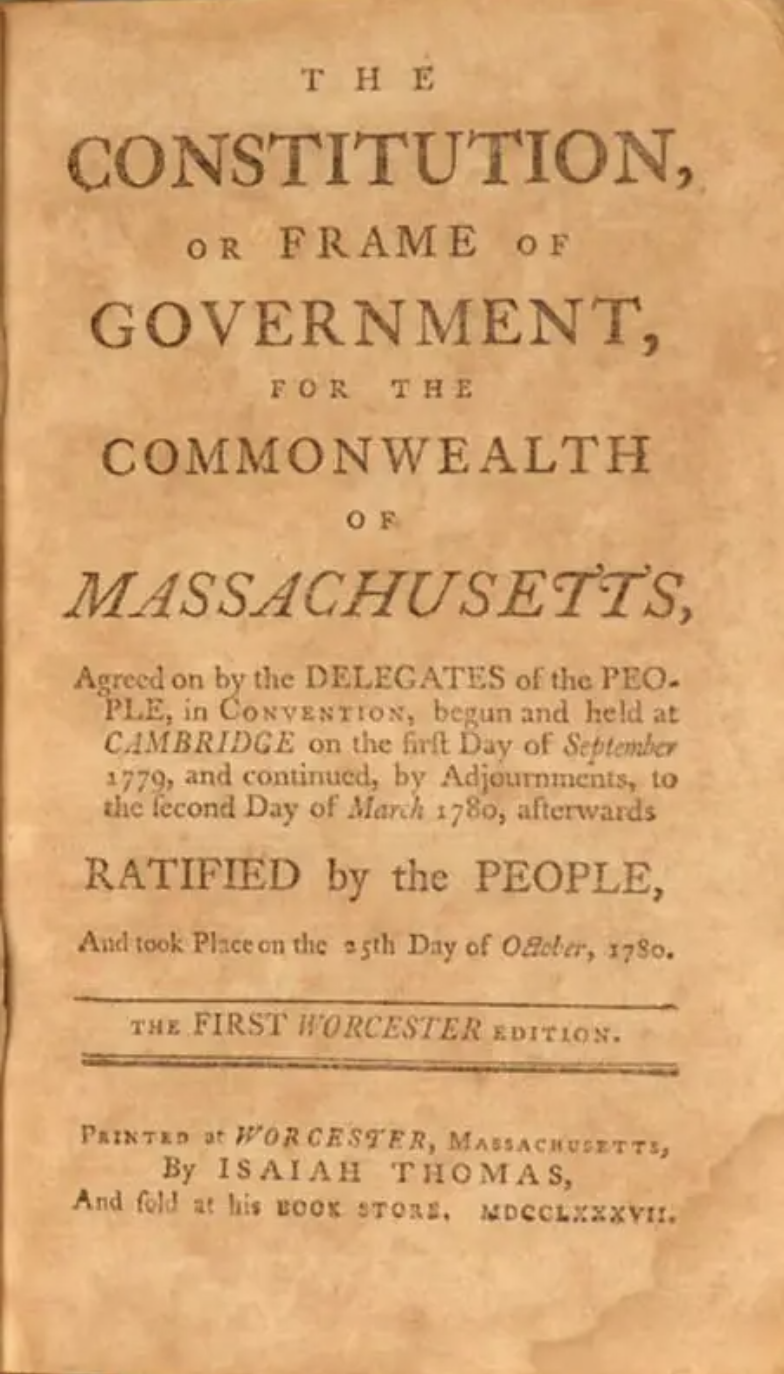
Reflective of revolutionary thought, this constitution confirms that: (i) men are born equal, free, and possess certain inalienable rights including freedom of conscience, and (ii) the power to govern is derived from the people, with all officers of government being accountable to them. Adopted a few years later, the Massachusetts Constitution of March 2, 1780, states:

III. As the happiness of a people, and the good order and preservation of civil government, essentially depend upon piety, religion and morality; and as these cannot be generally diffused through a community, but by the institution of the public worship of GOD, and of public instructions in piety, religion and morality… 

In the colonial mind, the principles of religion and morality serve as pillars of self-government and a free republic and are woven in many state constitutions. They also recur in many of the writings of the Founders, including Washington’s Farewell Address.

Another primary purpose of the state constitutions was to democratize the state legislatures. For example, all 1776 state constitutions provided for annual elections, most established bi-cameral legislatures, and term limits such as four years. Some contained unique features such as Pennsylvania which had a twelve-member executive council (instead of a governor), a unicameral legislature, and a Council of Censors, whose duty was to identify constitutional violations. The object was to limit legislative power and allow for expanded representation, which also resulted in many ordinary folk being elected to legislatures. Another universal feature of the constitutions was to divide and separate the legislative, executive, and judicial powers. 

The colonists were very familiar with the writings of Montesquieu who wrote, “When the legislative and executive powers are united in the same person, or in the same body of magistrates, there can be no liberty.” For example, the Virginia Constitution of June 29, 1776 reads: “SEC. 3. That the legislative and executive powers of the State should be separate and distinct from the judiciary…” and many others had similar, distinct provisions for the separation of powers. They believed that this was critical to the protection of individual liberty. However, if the state constitutions had a democratic weakness, it was that none were ratified by the people directly, as was the U. S. Constitution in state ratifying conventions.

In contrast to state constitutions, the Articles of Confederation fell short of the revolutionary ideals set forth in the Declaration of Independence in several respects:

• The Articles formed a confederation of the States –not ratified separately by the people. 
• The Articles created a single Congress which exercised legislative, executive, and judicial powers, thus violating the principle of separation of powers. 
 • There was neither a bicameral legislature, nor an executive that could execute the laws with requisite authority, nor a Bill of Rights to protect the natural rights of citizens. 
• The Articles required unanimous approval of the States to be amended.
In their operation, unlike the Constitution, the Articles generally failed to properly secure the people’s natural rights with appropriate checks on federal powers. 

While delegates had term limits, they were to be “appointed in such manner as the legislatures of each State shall direct.” Regarding the necessity to rule by “consent of the governed” in his essay titled Vices of the Political Systems of the United States, James Madison noted that “in some of the States, the Confederation is recognized … [as] part of the [State’s] Constitution … however [in others] it has received no other sanction than that of the Legislative authority.” Hamilton argued that it was a “gross heresy” that State legislatures have a right to revoke and elect to withdraw from the compact (Federalist No. 22). The multiplicity, mutability, and injustice of State laws were other vices identified by Madison under the Articles.

Practically speaking, the federal confederacy governed with unchecked and unbalanced powers, an unequal system of taxation, and a lack of unified provisions for the regulation of commerce and common defense. Without the practical ability to collect taxes and obtain consistent revenues, the government couldn’t function. And with nine States required for approval of any Congressional act, the structure proved lopsided and feeble in its application. As a consequence of its weaknesses and shortcomings, the Articles became a source of contention among the States, particularly between the larger States versus the smaller ones.
 
In Federalist No. 15, Alexander Hamilton said that the fundamental imperfections of the Articles of Confederation were in substance admitted by both opponents and friends of the new Constitution, and he proceeded to list these imperfections and “errors in the building,” arguing that as a result they had “reached almost the last stage of national humiliation”:

• Debts owed to foreigners and citizens 
• Territories and posts yet to be surrendered by foreign powers 
• Lack of troops and treasury to repel aggressions 
• Collapse of public credit 
• Diminution of land values 
• Scarcity of money

In order to forge an effective Union of the people under a new Constitution, the primary vice of the Articles of Confederation had to be confronted -- that the State governments operate “in their corporate or collective capacities as distinguished from the individuals of which they consist,” i.e., the national government under the Articles had no direct authority over individual citizens. In order to do this, Hamilton implicitly confirms that “the People” are sovereign -- based on their individual natural rights, and thus they are the ones creating a new compact between themselves and the federal government, not the States. He argues that only by adhering to this “first principle” and “main pillar” can they form “the characteristic difference between a league and a government; [and] extend the authority of the Union to the persons of the citizens, -- the only proper objects of government.” Correcting the significant defects of the Articles was the task of the Constitutional Convention of 1787, which ultimately led to a new federal constitution.

Sunday, May 4, 2025

The Birth of American Federalism


The existence of the states pre-dated the Constitution, having formed (as thirteen colonies) an embryonic union upon the adoption of the Declaration of Independence. The states continued as relatively independent, sovereign entities under the Articles of Confederation. As the Constitutional Convention approached, James Madison wrote that he had “sought for some middle ground, which may at once support a due supremacy of the national authority” while not excluding the states as “subordinately useful.” This effectively framed the great dilemma of federalism: how do you delegate and vest supreme authority and sovereignty in the new national or federal government while retaining sufficient authority and subordinate sovereignty in the state governments? Can imperium in imperio actually exist and function? 

First, the federal government was designed to be limited in its power, with the bulk of power reserved to the states or retained by the people. As Madison said, “The government of the United States is a definite government, confined to specified objects. It is not like the state governments, whose powers are more general.” The limited or “definite” powers delegated by the people to form the national republic were intended to create a separation and balance, not only between the branches of government (executive, legislative and judicial), but also between federal and state authority. The ultimate objective of these limitations was to protect and preserve individual liberty and self-government while guarding against tyranny. 

Secondly, Madison confirmed this constitutional objective and described the rationale for a dual or “compound” republic with shared sovereignty: 

In the compound republic of America, the power surrendered by the people is first divided between two distinct governments, and then the portion allotted to each subdivided among distinct and separate departments. Hence a double security arises to the rights of the people. The different governments will control each other, at the same time that each will be controlled by itself (Federalist No. 51). 

Thus, under federalism: (1) a “double security” is provided to protect the rights of the people, and (2) the federal and state governments are to “control each other.” However, this dual sovereignty was not easy to achieve. 

Finally, in the Constitutional Convention debates held in the summer of 1787, the inherent tension between proposed federal and state powers, as well as the potential imbalance of political influence between large and small states in the new national legislature were plainly manifested and vigorously argued. The issue that loomed the largest in the debates was centered on representation – how would the people individually and the states themselves be represented in the national legislature? 

The Virginia Plan proposed that the national legislature should be bi-cameral and that: “the people of each State ought to elect the First Branch of the National Legislature; [and] the Second Branch of the National Legislature ought to be elected by the first, out of a pool of candidates nominated by the state legislatures.” After prolonged debates, the large and small state delegates reached a concession, known as the “Connecticut Compromise.” Madison himself confirmed that the provision to be adopted would be “partly federal, partly national,” by letting “the people be represented and the votes be proportional [in the House]. In all cases where the Government is to act on the States as such … let the States be represented and the votes be equal [in the Senate] (note: as originally established, the state legislatures elected their U.S. Senators). This great compromise between the large and small states formed a significant core of American federalism under the Constitution.