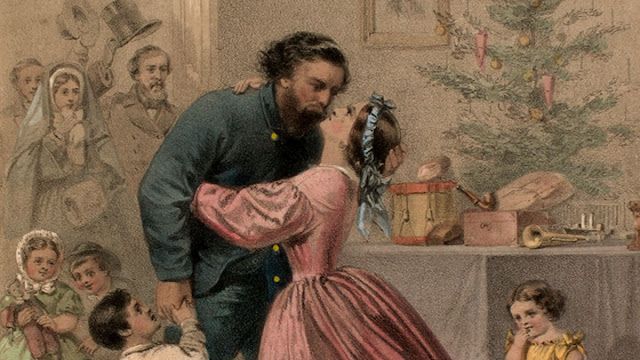
“As the Civil War’s first Christmas neared, a pair of young lovers, Nathaniel Dawson and Elodie Todd, a Confederate soldier and his eventual bride, wrote to one another with increasing melancholy. They were separated by hundreds of miles, and their communication was often interrupted by delays in the mail and the desperation of the Civil War.
“I wish I could be with you at Christmas, the festal season, where age is rejuvenated and lives again in the merry carols of youth,” Dawson wrote to Todd (sister of Mary Todd Lincoln) on December 22, 1861... Dawson and Todd’s lives changed dramatically during the war, as the Confederacy crumbled and their personal lives stretched to their limits. But they weren’t alone in wishing they could celebrate Christmas together. As the fractured United States fought, the holiday [grew in significance in both the South and the North]...
Before the Civil War, Christmas was not an official holiday in the United States. Nor was it celebrated uniformly across the country. In early New England, Christmas was looked down upon by Puritans and Calvinists, who felt the day should be observed for strict fasts and rituals, if it was observed at all. During the 17th century, Massachusetts imposed a fine on colonists who celebrated the holiday, and after it became a state, its businesses and schools did not observe the holiday at all.
Elsewhere, Christmas was celebrated in a variety of ways, most depending on the country of origin of the immigrants who celebrated it. But by the mid-19th century, the holiday’s importance—and distance from religious tradition—was already starting to grow. Songs and carols like “Jingle Bells” (1857) and poems like “A Visit from St. Nicholas” (1823) set the stage for a fun, secular holiday that revolved around gift-giving and celebration with food and drink.
In the antebellum South, plantation owners used the holiday as a way to show off their paternalism toward the people they enslaved, write historians Shauna Bigham and Robert E. May. During lengthy Christmas celebrations, they gave enslaved people passes to marry, provided food and alcohol, and gave gifts.”[1]
“During the Civil War, proclaiming religious holidays was one of [Abraham] Lincoln’s main cultural means of encouraging the spirit of “unionism” that the poet Walt Whitman identified as the “hard-pan of his character.” To this end, Lincoln issued nine religious proclamations—far more than any other U.S. president...
Lincoln thought that holidays had the capacity to unite people—in his words, “they bring us together, and thereby make us better acquainted, and better friends than we otherwise would be … They make more pleasant, and more strong, and more durable, the bond of social and political union among us...”
During Lincoln’s presidency... Christmas took on new meaning. Chiefly responsible for its transformation was the famous German American illustrator Thomas Nast, who created the modern Santa Claus—the jovially pipe-smoking, white-bearded, red-suited night flyer we know so well—and made him distinctly pro-northern and antislavery. Nast, a Lincoln devotee, put his Santa in politically charged scenarios. One of his first distinctive illustrations, on the cover of Harper’s Magazine in January 1863—the month Lincoln issued the Emancipation Proclamation—showed Santa delivering presents to Union soldiers in an army camp. Nast’s Santa, quite literally, embodies the North: He is clad in stars and stripes, surrounded by cheering Union soldiers, and holds in his hand a toy puppet of Jefferson Davis being hanged by the neck—a reminder of the improvised line in “The John Brown Song,” “We’ll hang Jeff Davis from a sour apple tree.”
Lincoln recognized the political significance of such illustrations. “Thomas Nast has been our best recruiting sergeant,” he said. “His emblematic cartoons have never failed to arouse enthusiasm and patriotism, and have always seemed to come just when these articles were getting scarce.” General Ulysses S. Grant, when asked who was “the foremost figure in civil life” during the war years, replied, “I think, Thomas Nast.”
During the second half of the Civil War, the North became more associated with Christmas. An 1863 political cartoon, “Santa Claus Visits Uncle Sam!,” showed Lincoln in a Santa outfit stuffing Union victories—Gettysburg, Vicksburg, Port Hudson, and others—into the nation’s Christmas stocking.”[2]
“By the end of the war in 1865, Christmas had gone from a relatively unimportant holiday to the opposite—a day rooted in an idealized vision of home. The way Americans observed the holiday changed too, setting the stage for the more modern Christmas holiday we know today.”[3]
________________________________
[1] Erin Blakemore, “How the Civil War Changed Christmas,” History Online, January 15, 2019 (https://www.history.com/news/civil-war-christmas)
[2] David S. Reynolds, “How Lincoln Turned Regional Holidays Into National Celebrations,” The Atlantic, November 24, 2021 (https://www.theatlantic.com/ideas/archive/2021/11/how-lincoln-redefined-thanksgiving-and-christmas/620800/)
[3] Blakemore, “How the Civil War Changed Christmas.”


